A football partnership becomes a different proposition when the audience can take part in it through something they wear or carry.
The relationship moves into people’s wardrobes, travel routines, and purchasing decisions. That creates possibilities for a brand, but it also introduces obligations that a campaign alone does not face. The product must justify its price. The design must work beyond the photograph. The customer needs a reason to choose it over something else.
MCM’s collaboration with adidas and FC Bayern Women brings those questions into focus.
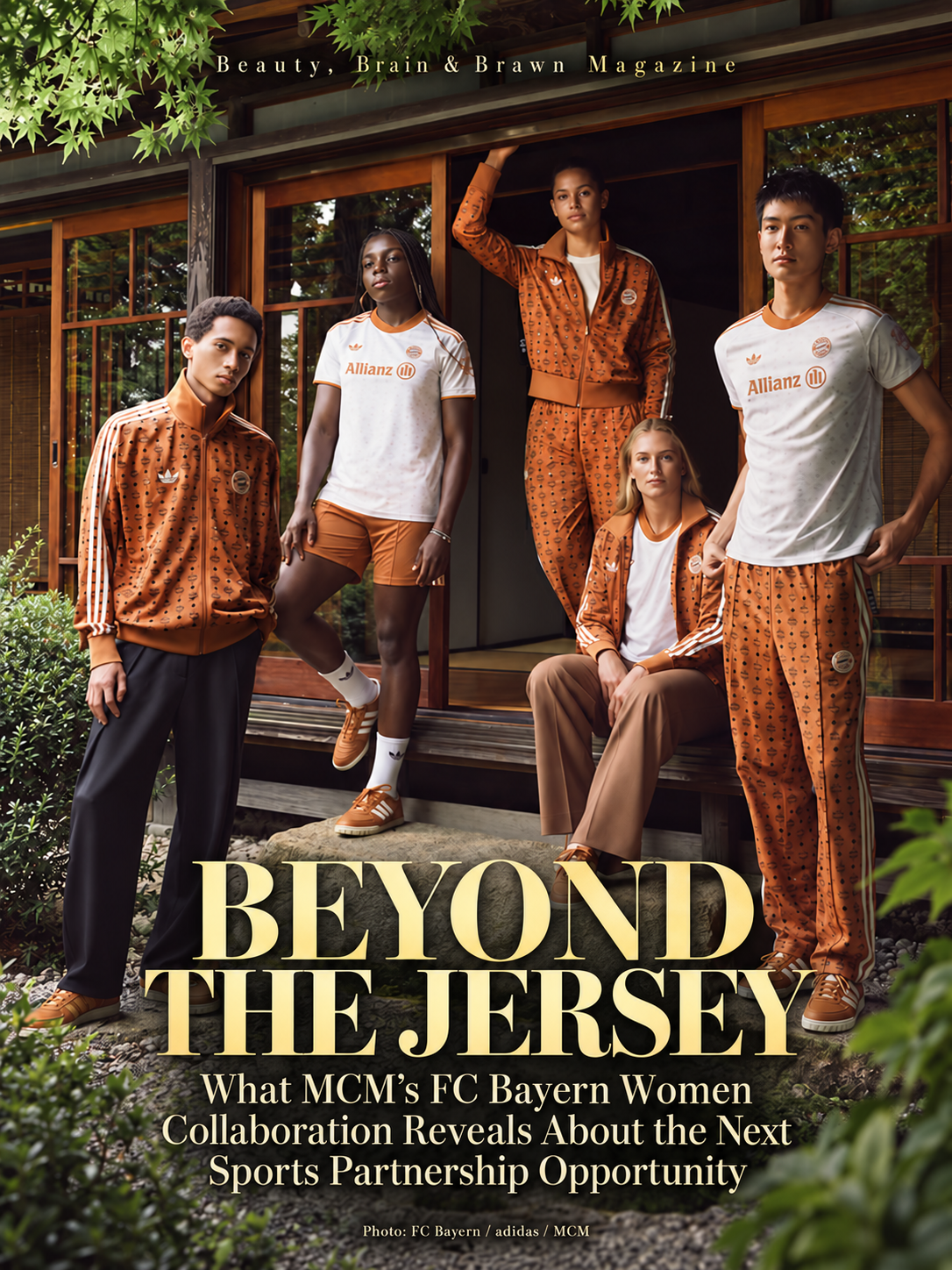
FC Bayern’s October 22 announcement introduced a special-edition jersey alongside bags, backpacks, lifestyle pieces, and footwear. The club said the collection was available through its online store and physical retail locations.
This was an anticipated part of the relationship. The July announcement established a two-year partnership between MCM and FC Bayern Women and identified an autumn collection among the plans. Both organizations also emphasized their Munich roots.
That sequence gives the story its substance. The partners built a pathway from affiliation to products. Whether customers follow that pathway is the next question.
A relevant occasion gives the partnership somewhere to begin
Travel is a useful connection between luxury and professional sport because it is already part of an athlete’s working life.
It creates practical requirements around luggage, clothing, organization, and comfort. It also produces visible moments between competition and everyday life, where athletes can express identities that a playing uniform cannot fully communicate.
For a travel-oriented brand, this offers a coherent starting point. There is an identifiable activity, a product that belongs within it, and a setting in which that product can be shown.
The same principle applies beyond luggage. A beauty brand might have a credible role in an athlete’s preparation routine. A fashion label might contribute to travel wardrobes or public appearances. A wellness business might address a defined recovery need.
Those are strategic possibilities, each requiring its own evidence and execution. The connection should remain understandable even after the announcement’s celebratory language is removed.
For founders, that is a useful test: can the partnership’s purpose be explained through what the product actually does?
Women’s football already has a fashion history
It would be misleading to describe this collaboration as the moment luxury discovered women’s football.
PSG’s official account of its Barbara Bui and New Era collaboration provides a relevant precedent. Barbara Bui had supplied the women’s team with custom travel and official wardrobes since 2023. The subsequent collaboration introduced three limited-edition caps, sold through PSG’s stores and online shop.
That example shows an existing pathway from dressing a team to developing products for consumers.
The MCM collaboration sits within that broader development. Its particular interest is the combination of luxury accessories, sportswear, and club identity across several product categories.
Beauty, Brain & Brawn Magazine’s assessment is that this structure can give each partner something useful. A fashion house gains a context for its design language. A sportswear partner brings expertise in familiar sporting categories. A club contributes identity, supporter relationships, and routes to retail.
But combining recognizable names does not automatically combine their customers.
The buyer is the unresolved part of the story
A supporter and a luxury customer can be the same person. They can also want very different things.
One may be drawn to an accessible expression of team loyalty. Another may judge the collection primarily on design, materials, and its place within a fashion wardrobe. A third may discover the team through the collaboration and have little prior connection to football.
Those motivations affect everything from product selection to pricing and campaign language.
A jersey may serve one purpose while a premium travel accessory serves another. Offering both can broaden the collection’s reach, but it also makes the commercial proposition more complex. The partners must understand which products attract existing customers, which bring in new ones, and whether those purchases continue after the initial launch.
Public attention cannot answer those questions. Neither can the appearance of a product on an athlete.
The announcements reviewed for this article do not disclose sales, margins, customer acquisition, or repeat purchasing. The collection should therefore be treated as a commercial proposition whose performance has yet to be established.
Meaningful evidence would include sales relative to inventory, full-price purchasing, customer overlap between partners, returns, and the ability to sustain interest beyond launch. A sellout would also need context about how much stock was available.
Distribution is part of the creative idea
The value of a collaboration depends partly on where it can be purchased.
FC Bayern’s announcement links the collection directly to club retail. That matters because it connects the campaign to an existing environment where supporters already shop.
For a smaller founder, access to that kind of distribution could be valuable. It can also create requirements around inventory, delivery, returns, wholesale pricing, and customer service that exceed the demands of an ordinary promotional partnership.
A founder considering an equivalent arrangement needs to understand the economics before committing to production. Who purchases the inventory? Who carries unsold stock? Which party handles returns? What costs sit outside the headline partnership fee?
These decisions shape whether increased exposure produces a stronger business.
They also affect the product itself. A collaboration intended for club retail may require different quantities, prices, and launch timing from a collection sold primarily to an established luxury audience.
The athletes’ role deserves attention
A women’s team can be central to a campaign without its players holding ownership or creative rights.
The public material reviewed here does not establish individual players’ royalties, equity, design ownership, or approval rights. Those benefits should not be inferred from participation.
That leaves an important question for the industry: how can commercial expansion around women’s teams create meaningful opportunities for the athletes involved?
The answer may vary. Paid campaign work, substantive creative input, professional exposure, and longer-term relationships can each have value. Their significance depends on the actual terms.
Brands should be clear about what they are asking athletes to contribute. A campaign appearance, product feedback, ongoing content production, and personal endorsement are different commitments. Treating them precisely makes the relationship easier to evaluate and manage.
What founders should take from this
The most transferable lesson is the relationship between product, occasion, and distribution.
A founder entering women’s sports needs to know where the brand belongs in the lives of athletes or fans, what it contributes there, and how the resulting interest can become a viable purchase.
For a beauty business, that might mean professional education connected to product trial, a carefully designed travel offering, or a preparation routine developed with credible athlete input. The appropriate model depends on the product and the customer. Simply placing a logo near a growing audience does not resolve those decisions.
The MCM, adidas, and FC Bayern Women collection is worth following because it makes the proposition tangible. There are products, a defined partnership, and retail channels through which customers can respond.
Its longer-term significance will depend on what happens after the campaign: what people buy, what they continue using, and whether the relationship earns another chapter.
For brands considering their own entry, that is where the strategic work begins.
Build a relevant partnership
Beauty, Brain & Brawn Consulting helps brands evaluate where they fit within women’s sports and develop partnership strategies grounded in product relevance, audience understanding, and commercial objectives. Explore more at BeautyBrainBrawn.com/advisory.
Sources
FC Bayern Women and adidas present exclusive MCM special edition. FC Bayern, October 22, 2026.
FC Bayern Women and MCM launch partnership. FC Bayern, July 21, 2026.
Paris Saint-Germain and Barbara Bui announce collaboration with New Era. Paris Saint-Germain. Publication date not displayed on the accessible page; accessed October 25, 2026.