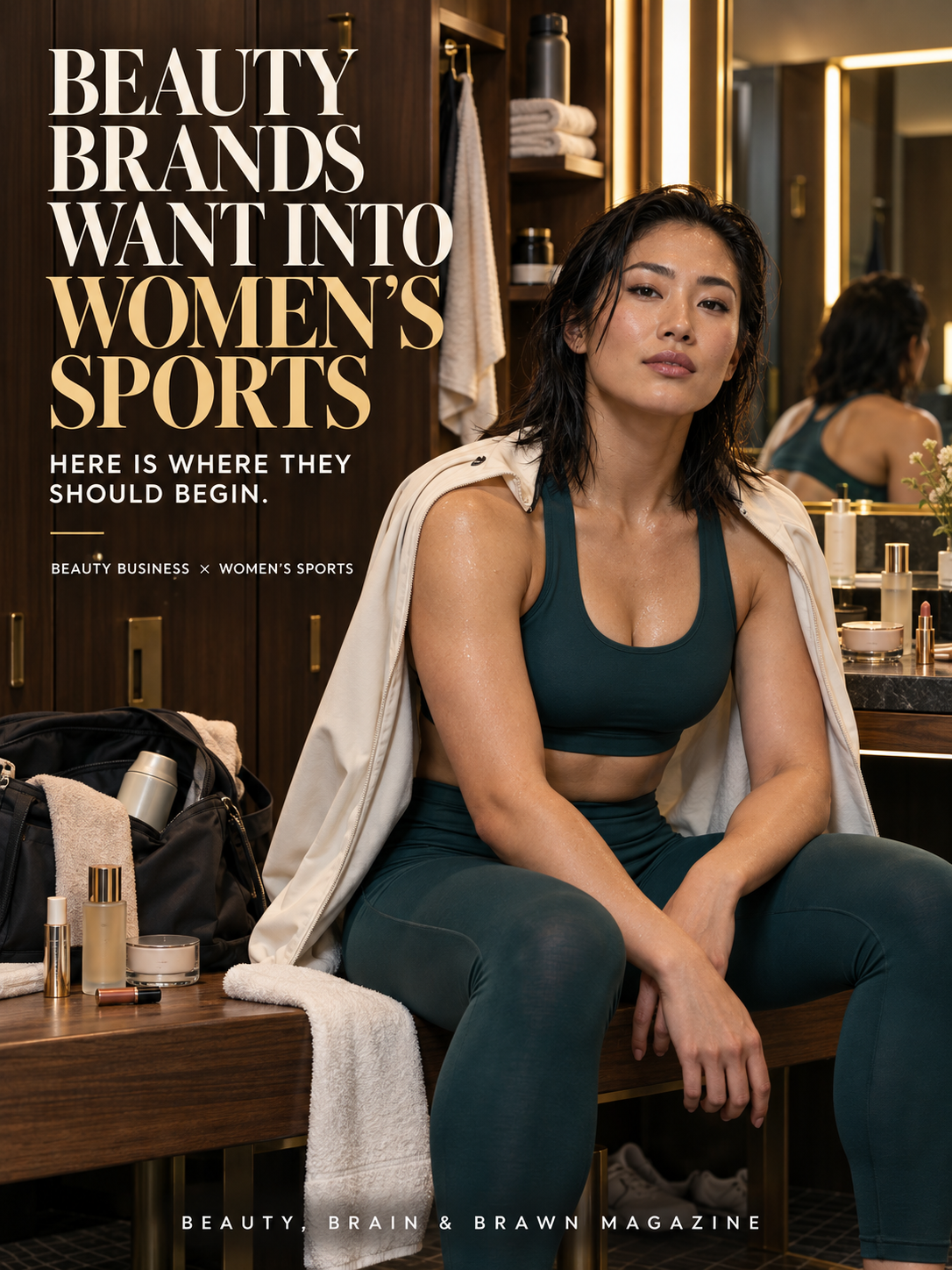
Women’s sports has become increasingly attractive to beauty brands.
The connection is not difficult to understand. Athletes are influencing conversations about hair, skin, personal style, confidence, wellness, identity and self-expression. Fans encounter them during competition, but also through tunnel arrivals, interviews, social media, business ventures, travel routines, recovery, fashion and life beyond the uniform.
Beauty brands are noticing.
Fenty Beauty and Fenty Skin became official beauty partners of the New York Liberty in 2025. Dove partnered with Gotham FC around its Keep Her in the Game initiative. Across women’s basketball and soccer, brands including Glossier, Mielle, Sephora, NYX Professional Makeup and Urban Decay have established partnerships with leagues, teams and athletes.
SponsorUnited’s 2025 women’s sports report, published in March 2026, identified more than 5,300 sponsorships across the category. That finding illustrates the expansion of the commercial ecosystem. It does not mean every market, property or opportunity is equally developed.
The growth of sponsorship creates a new challenge for beauty companies: entering women’s sports thoughtfully before the most visible spaces become crowded, expensive and difficult to differentiate within.
Recognizing the opportunity is not the same as knowing how to enter it.
Sponsorship Is Not the Strategy
The most visible partnerships can make women’s sports entry appear deceptively simple.
A brand identifies a team or athlete, signs an agreement, provides products, places its logo, creates social content and announces that it is supporting women.
That may produce visibility. It does not necessarily produce strategic value.
A sponsorship is one commercial mechanism within a larger market-entry strategy. Before selecting a property, the brand must understand what it wants the relationship to accomplish.
Is the objective to:
- Introduce the brand to a new audience?
- Increase product trial or sales?
- Build credibility around performance?
- Generate relevant content?
- Support a community initiative?
- Learn from athletes’ product needs?
- Establish authority within a particular city or sport?
- Develop a long-term association with women’s ambition and identity?
These goals require different partners, rights, budgets, activation plans and measures of success.
A national league partnership may offer scale but limited intimacy. A relationship with one athlete may create a more personal story but depend heavily on her schedule and public profile. A local team may offer less reach but more community access. An emerging sports property may provide flexibility and first-mover value while carrying greater uncertainty.
The strategic question is not simply, “What can we sponsor?”
It is, “Where can this brand play a credible and valuable role?”
The Five Entry Points
1. The individual athlete
An athlete can serve as an ambassador, campaign subject, content collaborator, product tester, spokesperson, licensing partner, creative contributor or investor.
These relationships are not interchangeable.
Product gifting gives a brand permission to send something. It does not guarantee use, coverage, endorsement or content.
A sponsored post purchases a defined piece of promotion. It does not necessarily create an enduring relationship.
An ambassadorship can establish longer-term association, but its value depends on exclusivity, content rights, appearances, category restrictions and the athlete’s actual connection to the product.
A collaboration or licensing agreement may use the athlete’s name, identity, creative contribution or intellectual property. Equity can create a deeper financial relationship, but it also requires careful evaluation of risk, governance and long-term fit.
Before approaching an athlete, the brand should evaluate more than follower count.
Relevant considerations include:
- Her sport and competitive calendar
- Audience composition and geography
- Hair, skin, beauty, wellness or performance needs
- Personal style and existing brand identity
- Cultural influence and community relationships
- Current partnerships and category conflicts
- Comfort with beauty content
- Interests beyond competition
- Career stage and long-term ambitions
The most commercially visible athlete is not automatically the most useful partner. A smaller but highly aligned athlete may provide greater credibility, creative access and relationship depth.
2. The team or league
A team or league agreement can provide official designation, venue exposure, hospitality, intellectual-property rights, content access, product integration, community programming and repeated engagement across a season.
Fenty Beauty and Fenty Skin’s New York Liberty partnership illustrates several of those possibilities. The brands received placement on pregame warm-up jackets and shooting shirts alongside in-arena activation opportunities. The relationship connects Fenty with a team identity, a home market and an ongoing competitive narrative rather than a single personality.
This structure can help a beauty company reach fans collectively. It may also provide access to players without requiring separate endorsement relationships with every athlete.
However, official rights are only the starting point.
A brand must understand:
- Which marks and terminology it may use
- Whether it receives venue, digital, broadcast or apparel visibility
- What athlete access is included
- Whether product sampling or sales are permitted
- Who controls content production and distribution
- What hospitality inventory is available
- Which expenses fall outside the rights fee
- Whether another beauty or personal-care partner already holds exclusivity
A company can spend heavily to become an official partner and still disappear inside the sponsorship environment if it does not reserve sufficient resources for activation.
The logo announces the relationship. The activation explains why it matters.
3. The event or competitive moment
All-Star weekends, tournaments, championships, drafts, season openers, expansion launches and athlete-led events can provide more flexible points of entry.
These moments frequently bring together athletes, media, executives, fans, creators and other brands within a concentrated period. That density can create opportunities beyond conventional signage.
A beauty company could develop:
- An athlete preparation or recovery suite
- A hair, skin, makeup or wellness experience
- A fan sampling and education program
- A founder or athlete conversation
- A content studio
- A hospitality event
- A product-testing environment
- A retailer or community partnership surrounding the event
This approach can be particularly useful for a brand testing women’s sports before making a multiyear commitment.
It can also fail when the concept has no meaningful relationship to the athletes or competition. A room filled with free products may create photographs and temporary excitement, but it does not automatically generate trust, useful feedback or commercial continuity.
The strongest event activation solves a problem, creates access or produces a story that can continue after the event ends.
4. The community surrounding the sport
Women’s sports does not begin and end with professional competition.
Youth programs, collegiate athletes, local clubs, coaching initiatives, development leagues, media platforms and organizations helping girls remain in sports all form part of the industry.
These spaces can offer beauty brands greater access, flexibility and community relevance than a large national sponsorship.
Dove’s Gotham FC partnership provides one example. The company connected its established work around body confidence with the club’s Keep Her in the Game initiative, which addresses barriers contributing to girls leaving sports.
The conceptual alignment matters.
Dove did not manufacture an unrelated message simply to enter a growing market. The partnership connected an existing brand platform with a documented issue affecting girls and young athletes.
Smaller brands can apply the same principle without attempting to replicate Dove’s scale.
A textured-hair company might support education and products for athletes managing demanding training schedules. A skincare brand might develop sun-protection programming around an outdoor sport. A wellness company might support recovery or travel education. A founder-led brand might partner with a local women’s team whose supporters overlap with its existing community.
The opportunity does not need to be enormous to be strategic.
It needs to be coherent.
5. The athlete’s identity beyond competition
Beauty companies should not limit their thinking to what happens during the game.
Women athletes are also navigating media appearances, travel, fashion, motherhood, entrepreneurship, injury, retirement, career transitions and the development of public identities beyond performance.
These areas create opportunities for partnerships built around the whole person.
A brand might support an athlete as she develops a new content platform, enters public speaking, launches a company, explores fashion or builds intellectual property beyond competition.
This territory can produce deeper stories than a traditional game-day endorsement because it recognizes that an athlete’s commercial influence does not begin when the camera turns toward the court or field. It is built through the way audiences understand her values, style, expertise, ambitions and evolution.
For beauty brands, that opens space to participate in identity rather than merely appearance.
Beauty Must Understand the Performance Environment
The beauty industry often speaks about performance. Women athletes offer an opportunity to define what that word means under actual competitive conditions.
Products used around sports may need to withstand:
- Sweat and repeated cleansing
- Movement and friction
- Sun, wind, heat or cold
- Protective equipment and uniforms
- Frequent travel
- Long competition days
- Broadcast cameras and arena lighting
- Transitions between performance and public appearances
Haircare must account for texture, protective styling, scalp health, wash schedules, extensions, braids, locs, wigs, helmets, sweat and limited time.
Skincare may need to address sun exposure, dehydration, sensitivity, breakouts, travel, friction and recovery.
Cosmetics may need to perform across physical activity, interviews, photography, competition and personal expression.
The athlete should not be treated only as the person who markets the solution. Her experience can help determine whether the solution is useful.
This creates a path from sponsorship into product intelligence.
A brand that listens carefully may discover unmet needs, overlooked product formats, packaging problems, educational opportunities or entirely new categories of use. That insight can be more valuable than a conventional endorsement because it informs what the company builds.
The Athlete Is Not a Blank Campaign Surface
Beauty brands must also understand that an athlete already has an identity before the partnership begins.
She has an audience, personal history, aesthetic, community, values, ambitions and existing commercial relationships. A strong partnership works with that identity rather than replacing it with a generic campaign concept.
Brands should consider:
- What territory does the athlete already occupy?
- What does her audience trust her to discuss?
- Which parts of her identity remain underdeveloped?
- What expertise does she possess beyond athletic performance?
- Is the proposed partnership supporting her evolution or temporarily borrowing her visibility?
- What will remain valuable to both parties after the campaign concludes?
The most effective athlete partnerships are specific enough that another athlete could not be substituted without changing the idea.
Not Every Opportunity Requires a Major Budget
Beauty brands frequently assume that entering women’s sports requires immediate access to the WNBA, NWSL, a major tennis tournament or a globally recognized athlete.
Those opportunities can be valuable. They are not the only options.
The ecosystem also includes:
- Emerging professional leagues
- Minor-league and developmental properties
- Individual and niche sports
- Collegiate athletes
- Local women’s teams
- Athlete-led businesses and events
- Sports-media platforms
- Community organizations
- Youth-development initiatives
- Athlete associations and alumni networks
A smaller brand may gain more from becoming essential to an emerging property than becoming one of many product providers at an established event.
Early entry can create category ownership, deeper access and room to co-create. It can also involve risk. Emerging properties may have smaller audiences, less established operations, incomplete measurement systems or uncertain longevity.
This is why opportunity evaluation matters.
Being early is only advantageous when the brand understands what it is entering.
The Opportunity Is Larger Than Sponsorship
Women’s sports is creating new commercial territory across media, events, products, communities, athletes and emerging properties.
Beauty brands possess expertise that can be relevant to this growth. They understand ritual, identity, presentation, confidence, community, product education and personal transformation. Those capabilities can translate meaningfully into sports when they are applied with intelligence and respect.
The strongest partnership will not look like a beauty brand borrowing attention from women athletes.
It will look like the brand contributing something the ecosystem can use.