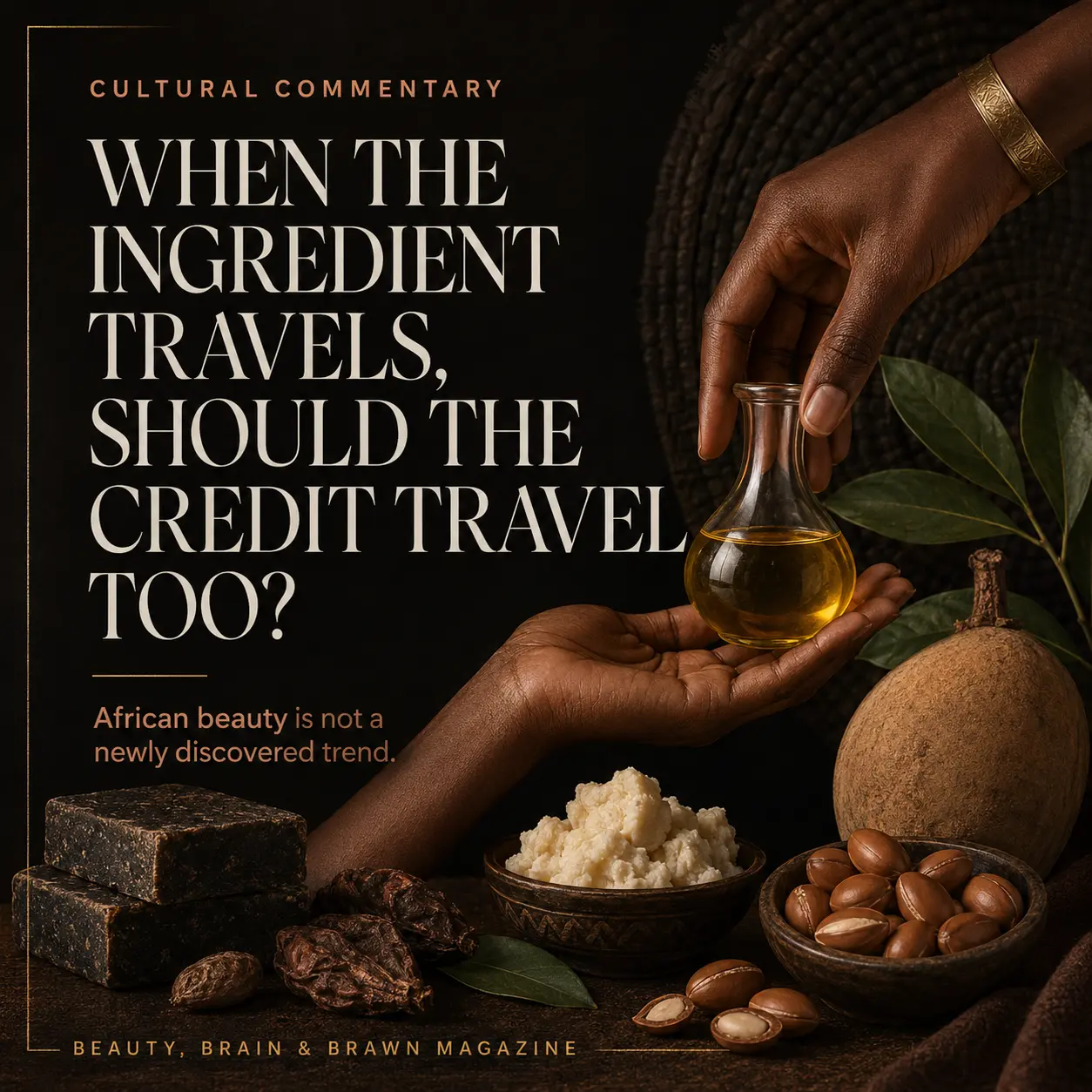
African beauty is having what the global marketplace likes to call a moment.
Shea butter, baobab, marula, moringa, black seed, qasil, argan oil and safou are increasingly visible in skincare, body care and wellness products. Their names appear on luxury packaging, retailer shelves and social feeds. Formulators describe their efficacy. Marketers celebrate their natural origins. Consumers encounter them as the next compelling discovery.
But these ingredients did not become meaningful when the global beauty industry discovered how to market them.
They arrived with histories.
They came from ecosystems, communities, rituals, agricultural practices and bodies of knowledge that existed long before they appeared in a trend report. In many cases, women preserved the techniques associated with cultivating, processing and using them across generations.
The question is not whether African ingredients should travel. Beauty has always evolved through exchange, curiosity, science and adaptation.
The more important question is what travels with them.
Does the ingredient retain its history? Are the people who cultivated the knowledge visible? Do producers share in the economic value? Can African and Black founders access the investment, manufacturing, retail relationships and distribution required to shape the category?
Or does the ingredient travel farther than the credit?
The Ingredient Is Never the Whole Story
A botanical ingredient can be analyzed in a laboratory, standardized for formulation and integrated into a sophisticated modern product. That scientific work matters. Effective beauty products require testing, technical knowledge, safety and consistency.
But scientific development does not erase cultural origin.
An ingredient can carry several kinds of intelligence at once. There is the biochemical intelligence examined by formulators. There is agricultural knowledge about where and how it grows. There is processing expertise. There is ritual knowledge about how communities have used it. There is also commercial intelligence involved in transforming it into a scalable, desirable product.
The beauty industry often celebrates the final form while overlooking the connected system of knowledge that made the final form possible.
That is how a familiar cultural staple can be presented to the global consumer as a surprising new discovery.
The language may change. The packaging may become more luxurious. A scientific name may replace a culturally familiar one. The product may appear in a prestige environment far removed from the ingredient's origin.
None of those developments is automatically exploitative. Innovation can honor tradition while creating something genuinely new.
The problem begins when transformation becomes erasure.
When Cultural Discovery Creates Commercial Distance
A recent Byrdie examination of African body care featured Sabrina Elba of S'ABLE Labs, Christina Funke Tegbe of 54 Thrones and Abena Boamah-Acheampong of Hanahana Beauty. The founders discussed the cultural traditions surrounding African botanicals, the need to preserve their stories and the danger of allowing African beauty to become a temporary commercial trend.
The article noted the growing visibility of ingredients including shea butter, baobab oil and argan oil. It also explored the disconnect between the popularity of African ingredients and the visibility, investment and infrastructure available to African beauty brands and producers.
That disconnect is the central issue.
The global industry can embrace an ingredient while remaining distant from the community that sustained it. A product can reference Africa aesthetically without building meaningful African economic participation. A marketing campaign can celebrate heritage without naming the people who hold that heritage.
Cultural proximity in the campaign does not guarantee economic proximity in the value chain.
Beauty, Brain & Brawn Magazine believes attribution must extend beyond an evocative origin story. If culture is used to create distinction, credibility or desire, then cultural knowledge cannot be treated as decorative packaging.
Credit must become part of the business model.
The Argument at a Glance
This Beauty, Brain & Brawn Magazine carousel captures the central questions surrounding African beauty ingredients, cultural credit and who benefits when traditional knowledge enters the global marketplace.
Swipe to explore
Credit Is More Than a Footnote
Meaningful credit begins with accuracy.
Brands should be able to explain where an ingredient comes from, how it has traditionally been used and who contributed to the knowledge informing the product. They should avoid presenting longstanding practices as newly invented discoveries.
Credit can also include hiring researchers, writers, chemists, historians and creative professionals who understand the cultural context. It means making local experts and producers visible without reducing them to background imagery.
However, attribution alone is not enough.
A beautifully written origin story does not answer who owns the company, who controls the intellectual property, who receives investment, who holds the retail relationship or how much value remains in the region where the ingredient originated.
Recognition can acknowledge influence. Ownership determines who benefits from it.
From Sourcing to Economic Participation
Ethical sourcing is often presented as the conclusion of the conversation. It should be the beginning.
Sourcing practices matter. Fair pricing, supply-chain transparency, safe working conditions, environmental responsibility and long-term supplier relationships can materially affect the lives of producers.
Hanahana Beauty offers one instructive example. According to B Lab's reporting, the company sources raw shea from the women-led Katariga Cooperative in Ghana and supports community healthcare and producer education through its Circle of Care initiative.
The point is not to turn one company into a universal template. Different ingredients, regions and business models require different approaches.
The larger lesson is that a supply relationship can be designed to recognize producers as participants rather than invisible inputs.
Economic participation may include:
- Fair and transparent pricing
- Long-term purchasing commitments
- Investment in processing capacity
- Technology that reduces physical strain
- Training and professional development
- Shared research opportunities
- Local manufacturing
- Community healthcare or wellness support
- Founder investment
- Distribution partnerships
- Retail access
- Intellectual property ownership
- Leadership and decision-making authority
A value chain reveals what a company truly values.
If the cultural story remains visible while the people disappear from the economics, the industry has preserved the aesthetic and lost the accountability.
African Beauty Is Also Modern Beauty Innovation
There is another limiting idea that deserves examination: the assumption that African beauty belongs exclusively to the language of tradition.
Tradition matters, but African beauty is not frozen in the past.
African and diasporic founders are combining inherited knowledge with formulation science, product design, modern manufacturing and global brand strategy. They are not simply translating rituals for an outside audience. They are building intellectual property and developing products with the potential to influence beauty at scale.
Vogue's reporting on the growth of A-beauty has highlighted founders and brands working across this continuum.
Thérèse M'Boungoubaya built Koba around safou oil, connecting her Congolese heritage with a modern body-care proposition. Valerie Obaze's R&R Skincare has worked to modernize the presentation and use of African-sourced ingredients while developing production capacity in Ghana. S'ABLE Labs combines African botanicals with contemporary skincare science. Other founders are building direct relationships with women-led producers and strengthening the commercial systems surrounding the ingredients they use.
These are not stories of culture waiting to be discovered.
They are stories of founders already doing the discovering, researching, formulating, manufacturing, financing and building.
The industry should not position African founders only as cultural translators. They must also be recognized as scientists, strategists, manufacturers, executives and owners.
Black Founders Cannot Scale on Visibility Alone
A founder can receive glowing editorial coverage and still lack the working capital required to produce inventory.
A brand can attract social engagement and still struggle to secure distribution.
A culturally significant company can appear in a retailer's campaign while lacking the financial runway, data access and shelf stability necessary to remain in that retailer.
This is why visibility is an incomplete measure of progress.
Visibility can introduce a founder. Infrastructure allows the founder to endure.
The infrastructure question includes capital, but it does not end there. It also includes manufacturing, testing, logistics, export systems, warehousing, retail education, technology, customer acquisition and experienced executive support.
It includes the ability to survive a delayed purchase order, a change in retailer strategy or a sudden increase in demand.
When African ingredients become globally desirable faster than African beauty companies can access infrastructure, the market creates an imbalance. The raw material travels. The cultural narrative travels. The finished opportunity does not travel at the same speed.
That is not a shortage of creativity. It is a question of access and power.
A Framework for Responsible Beauty Innovation
Responsible innovation does not require brands to stop exploring ingredients across cultures. It requires greater intelligence about how that exploration is conducted.
Beauty, Brain & Brawn Magazine proposes eight questions:
01Can you trace the origin?
Know the ingredient's geographic source, processing journey and supply-chain relationships.
02Can you credit the knowledge?
Identify the cultural practices and communities connected to the ingredient without manufacturing a discovery story.
03Are the relationships direct and durable?
Favor transparent, long-term relationships over temporary sourcing arrangements built around a trend cycle.
04Who shares in the economic value?
Examine compensation, ownership, local processing, employment and community investment.
05Are founders receiving infrastructure as well as attention?
Visibility should be accompanied by capital, manufacturing support, distribution and decision-making access.
06Is the history documented responsibly?
Work with qualified cultural experts, researchers and community voices. Do not reduce an entire continent to a single beauty narrative.
07Can the product demonstrate meaningful innovation?
Cultural reverence and modern science can coexist. Brands should be clear about what is traditional, what is newly developed and how the two interact.
08What remains after the trend moves?
A responsible relationship should leave behind capacity, opportunity, documentation and durable economic participation.
Beauty, Brain & Brawn
The Beauty, Brain & Brawn framework offers a useful way to understand what is at stake.
Beauty is the visible expression. It is the ingredient, ritual, texture, packaging, sensory experience and cultural resonance that attract attention.
Brain is the intelligence. It includes ancestral knowledge, agricultural expertise, formulation science, consumer insight, research and business strategy.
Brawn is the infrastructure. It is ownership, investment, manufacturing, distribution, protection, negotiating power and the ability to remain in the market.
The industry often wants the beauty.
It increasingly recognizes the brain.
The next test is whether it will invest in the brawn.
African beauty should not have to surrender its context to achieve global scale. An ingredient should not need to become culturally anonymous before it can be treated as universally relevant.
The strongest future for beauty is not one in which tradition is protected from innovation. It is one in which innovation expands the value of tradition without disconnecting that value from its source.
When culture creates the value, culture should not be edited out of the value chain.
When the ingredient travels, the history should travel. The expertise should travel. The opportunity should travel. The ownership should travel. The credit should travel.
Sources
- Byrdie, “African Body Care Is Not a Trend,” published August 8, 2026
- Vogue, “Is African Beauty the Next Big Global Trend?” published October 27, 2025
- B Lab U.S. & Canada, “How Businesses Use Ethical Sourcing to Support Women in Africa”
- UN Trade and Development, “Harnessing the Potential of Nutraceutical Products for Export Diversification and Development”