The most interesting athlete partnerships are no longer asking a woman to stand beside a product and lend it her visibility. They are beginning to ask a more valuable question: What can be created from her distinct world?
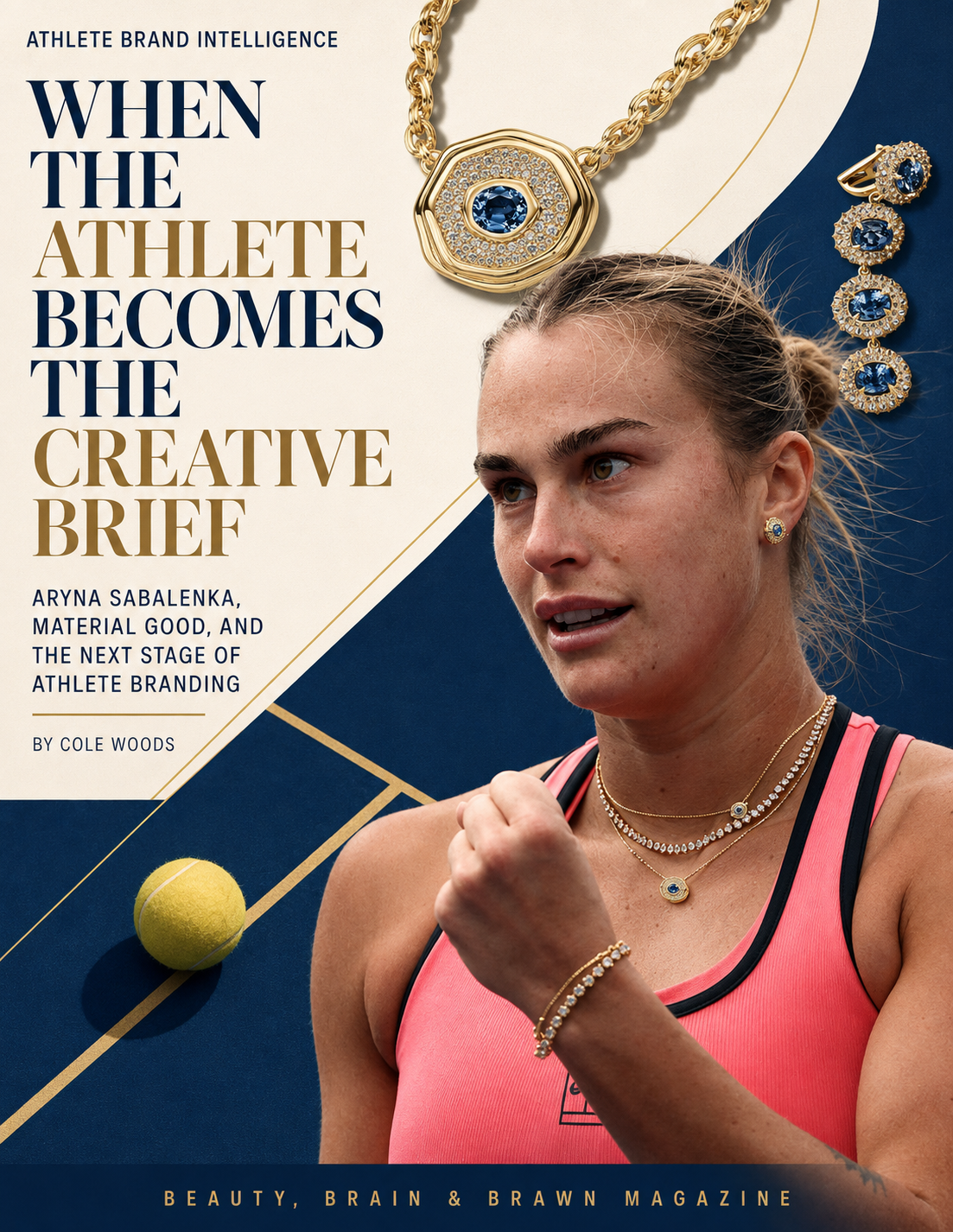
At the 2026 US Open, Aryna Sabalenka walked onto the court wearing a multicolored fine-jewelry suite created by Material Good. The pieces were visually striking, but their real significance was not measured in gemstones or carats. It was found in the process behind them.
Material Good’s designers considered the neckline of Sabalenka’s tournament wardrobe, her preference for bold jewelry, the way she jumps and runs, the movement of a bracelet on her arm, the possibility of an earring striking her face, and even the need to prevent a necklace from trapping sweat during competition. The jewelry had to carry the weight and finish of luxury while functioning in one of the most physically demanding and visible settings in sports.
This was not simply a case of placing a recognizable product on a famous athlete. Sabalenka’s identity, style, environment, and physical expertise became inputs into the creative process.
That makes the partnership a revealing case study in the next stage of athlete branding.
The Difference Between Exposure and Translation
Traditional endorsement strategy begins with a product that already exists. The athlete’s role is to attract attention to it, validate it, or make it culturally desirable.
That model can be commercially effective. It can also be interchangeable.
If the campaign could replace one athlete with another without materially changing the idea, then the partnership is using recognition more than identity. The athlete is visible, but she is not necessarily essential to the product story.
Translation works differently.
It begins with the athlete’s specific world: what she values, how she moves, what she wears, the communities she represents, the rituals that support her performance, and the way she wants to be understood. Those qualities are then translated into a product, experience, or narrative that would not exist in quite the same form without her.
Material Good describes Sabalenka as its first jewelry ambassador and says the partnership is rooted in self-expression and craftsmanship. The company maintains a retail collection bearing her name and says she will continue wearing custom creations on and off the court throughout the 2026 season. Material Good’s collection page therefore shows a relationship designed to extend beyond one tournament appearance.
The commercial platform is recurring. So is the creative material.
Every tournament can introduce a new setting, wardrobe, physical requirement, color story, or emotional moment. Instead of forcing the same campaign into multiple environments, the collaboration can evolve with the athlete.
Performance Knowledge Is Creative Intelligence
One of the most important details in this partnership is that the design process had to respect Sabalenka’s work.
According to an August 25 interview with Material Good’s Head of Design Atara Lev and Director of Marketing Teresa Panico, the company received advance access to her tournament kits and considered how the jewelry would sit against different necklines. The team tested necklace lengths, adjusted chains, created detachable earring components, and considered the weight and movement of each piece. Sabalenka reportedly tests the jewelry during practice before wearing it in a major match. Town & Country’s interview documents those functional considerations.
This is where the athlete becomes more than talent.
Sabalenka possesses knowledge that the design team cannot manufacture independently. She knows what it feels like to serve, sprint, rotate, sweat, and compete under pressure while wearing the pieces. Her body provides feedback. Her preferences define the acceptable range. Her performance environment tests whether the design succeeds.
That expertise has creative value.
Athletes are often invited into campaigns after the most consequential decisions have already been made. The product, message, aesthetic, and distribution plan may all exist before the athlete enters the room. She is then expected to make the finished idea feel authentic.
A stronger partnership brings her intelligence into the process earlier.
The lesson extends beyond sports. The people closest to a problem frequently possess the insight required to create a better solution. A founder understands the customer behavior hidden behind the analytics. A stylist understands how a garment behaves on different bodies. A beauty professional understands why a technically correct shade match may still fail in real life. A former athlete understands the psychological and physical realities that a brand brief might overlook.
Expertise becomes most valuable when it is treated as an input, not merely used as decoration.
A Personal Brand Should Give Partners Something to Build With
Sabalenka’s value to this partnership is not limited to her ranking or audience. Material Good’s representatives describe an athlete who genuinely enjoys luxury jewelry, prefers bold pieces, embraces color, and carries that sensibility both on and off the court.
That consistency matters.
A strong personal brand is not a collection of random interests optimized for sponsorship. It is a recognizable point of view that remains coherent across environments.
For an athlete, that may include her competitive temperament, aesthetic preferences, cultural identity, interests outside sport, causes, expertise, humor, rituals, or ambitions beyond competition. None of those dimensions diminishes her athletic credibility. Together, they give partners more specific material from which to create.
The strategic question is not simply, “What brands would pay to be associated with me?”
It is, “What becomes possible because I am the person in the partnership?”
That question changes the objective. The goal is no longer to appear compatible with the largest possible number of brands. It is to become legible enough that the right partners can see a distinct creative and commercial opportunity.
Specificity does not make an athlete less marketable. Used intentionally, it makes her less interchangeable.
From Campaign Moment to Commercial Infrastructure
An endorsement can create income and attention. A well-developed partnership can create infrastructure.
Infrastructure may take the form of a recurring collection, a signature product, a licensing agreement, an owned media property, a creative studio, a long-term ambassador relationship, or a platform that can continue after the competitive chapter changes.
The Sabalenka and Material Good relationship offers some evidence of that progression. It includes custom designs across multiple Grand Slam tournaments, an official ambassador designation, and a branded retail collection. The athlete’s identity can generate new stories and products over time rather than disappearing after one advertising cycle.
However, precise language is essential.
Public sources establish that Sabalenka is an ambassador, wears bespoke jewelry, participates in a collaborative process, tests the pieces, communicates preferences, and has a retail collection bearing her name. Those sources do not disclose whether she owns any designs, receives royalties, licenses her name, holds contractual approval rights, or has equity in Material Good.
These are not minor technicalities. They represent different levels of leverage.
Visibility means the athlete can attract attention.
Influence means her identity or preferences shape the outcome.
Authorship means she has a recognized role in creating the work.
Licensing means defined intellectual property is being commercially used under agreed terms.
Ownership means she retains a durable stake in the asset, company, or value being created.
One level is not automatically inferior to another. A well-paid ambassadorship may serve an athlete’s goals perfectly. But as women’s sports attracts greater commercial investment, athletes and their advisors should understand exactly which form of value is being exchanged.
The language used publicly should not imply ownership where none has been established. At the same time, the absence of disclosed ownership should not obscure the creative significance of a genuinely customized partnership.
What Brands Should Learn
Brands entering women’s sports should resist the temptation to treat athlete partnerships as a shortcut to relevance.
An athlete is not a media placement with a pulse. She is a person with expertise, history, taste, ambition, and a community that can recognize when a collaboration has substance.
The most credible partnerships begin with discovery. What is already true about the athlete? What does she genuinely use, understand, or care about? Which parts of her identity are underdeveloped commercially? What could the brand build with her rather than simply place around her?
Material Good’s story is instructive because the relationship reportedly began organically when Sabalenka visited the company’s boutique. The brand recognized an authentic alignment between her personal appetite for adventurous jewelry and its own aesthetic. From there, the partnership developed around what she would actually wear while doing her job.
That is a more durable foundation than selecting an athlete solely because her audience matches a demographic target.
Brands should also create room for feedback that can change the work. If an athlete’s contribution cannot alter the product, campaign, or experience, then the company may be seeking endorsement rather than collaboration. There is nothing inherently wrong with that, but the distinction should be honest.
What Athletes Should Build Before the Deal Arrives
Athlete branding is often discussed as a content problem: post consistently, grow an audience, and make yourself visible to sponsors.
Visibility helps, but it is not the foundation.
The more durable work is identity development.
An athlete should understand the values, interests, experiences, aesthetics, and ambitions that remain true when the scoreboard is removed. She should know which parts of her story belong to the public, which should remain private, and which can become intellectual property, programming, products, partnerships, or platforms.
She should also develop the language to explain her value without reducing herself to statistics or follower counts.
This work is useful even when no sponsorship is imminent. It gives the athlete a framework for evaluating opportunities, protecting coherence, and building toward a career that does not expire when competition ends.
The strongest personal brands do not merely attract partners. They help the athlete recognize which partnerships deserve access to her identity.
Beyond the Court
The significance of Sabalenka’s jewelry partnership is not that every athlete should pursue fashion or luxury. It is that a highly specific part of her identity became commercially legible without requiring her to separate it from performance.
Her athleticism did not disappear beneath the jewelry. It created the design challenge. Her movement was not an obstacle to the fashion story. It was part of the brief.
That is the opportunity forming around women athletes now.
The athlete can be competitor, expert, collaborator, storyteller, and commercial platform at the same time. But those possibilities become more valuable when everyone involved understands the difference between being seen, shaping the work, and owning what the work creates.
The next stage of athlete branding will not be measured only by how many products a woman can promote. It will be measured by how effectively her identity can inform products, narratives, and assets that remain recognizable beyond a single campaign.
The essential question is no longer whether the athlete is visible enough.
It is whether her identity is developed enough to become the creative brief.
Source and Methodology Note
The factual descriptions of Material Good’s ambassador relationship, retail collection, custom Grand Slam suites, design process, product testing, and 2026 US Open jewelry are based on Material Good’s current collection page and Town & Country’s August 25, 2026 interview with Material Good executives Atara Lev and Teresa Panico. Analysis concerning athlete identity, commercial infrastructure, authorship, licensing, ownership, and leverage represents the editorial interpretation of Cole Woods and Beauty, Brain & Brawn Magazine. Publicly available sources reviewed for this article do not disclose Sabalenka’s compensation, royalties, licensing terms, approval rights, design ownership, or equity.