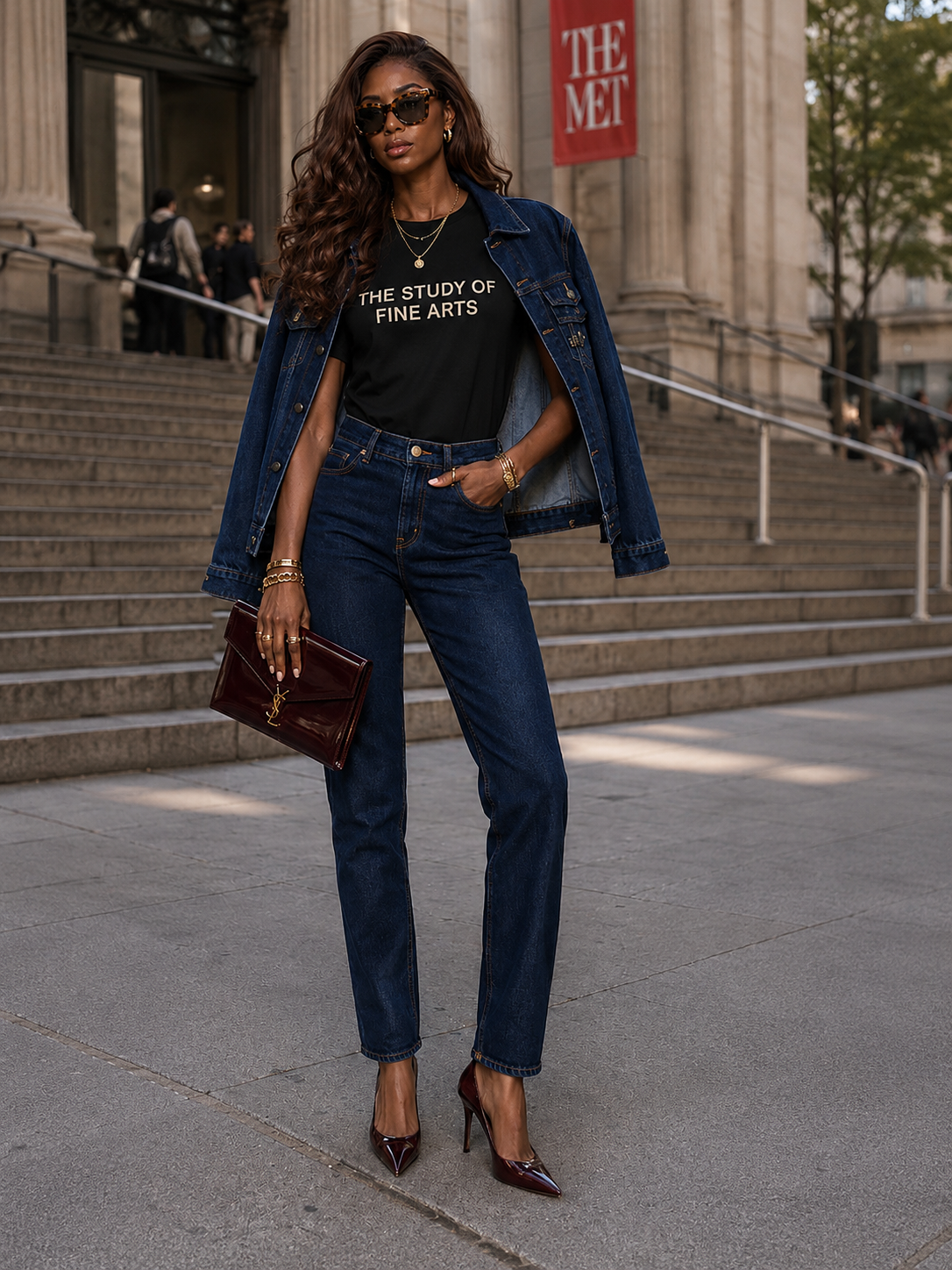
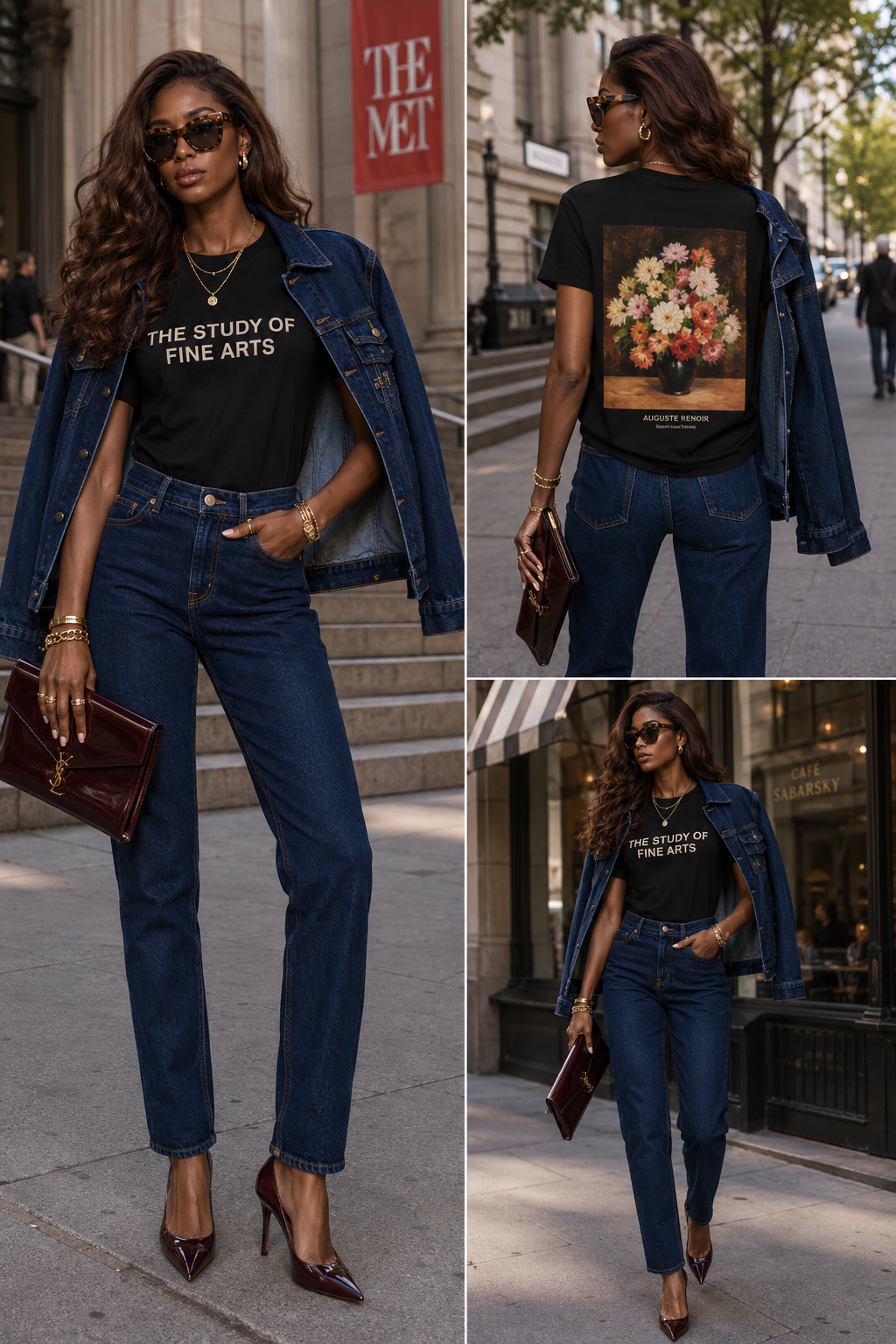
I recently came across a PacSun x The Met collaboration capsule and found myself immediately drawn to a particular t-shirt that read “The Study of Fine Arts.” On the back was a Renoir floral print that softened the structure of the piece in a way that felt unexpectedly thoughtful.
At first glance, it was just a graphic tee.
But somewhere between styling the look, visualizing it with AI, and refining the accessories, I realized I wasn’t simply building an outfit.
I was studying myself.
That may sound dramatic to some people, but I think many women intuitively understand what I mean. There are certain pieces that resonate beyond trend or practicality. Sometimes clothing reflects something back to us that we already know internally, but haven’t fully articulated yet.
For me, this look became a conversation about identity, intentionality, and the increasingly fascinating role AI can play in how we engage with fashion.
Visualization Before Acquisition
One of the things I discuss in Pretty Smart: Fashion Intelligence is the idea that AI has the ability to fundamentally shift our relationship with consumption.
Traditionally, fashion shopping has been highly aspirational and emotionally driven. We see a product on a model, influencer, mannequin, or Pinterest board and project a fantasy onto it. Often, we purchase first and evaluate later.
But AI visualization creates a different experience.
Instead of blindly imagining how a piece might fit into your life, aesthetic, proportions, or identity, you can now explore the concept before making the purchase.
Not every visualization leads to a buy.
In fact, many of my visualizations help me realize: something doesn’t suit me; a silhouette feels disconnected from my actual lifestyle; the styling doesn’t align with my visual language; or the fantasy simply doesn’t translate in practice.
That kind of clarity is incredibly valuable.
Ironically, AI visualization has actually made me more intentional about fashion, not less.
The Difference Between Attraction & Alignment
What fascinated me most during this styling process was realizing that by the time I visualize a true “must-have,” my decision is often already emotionally made.
The visualization isn’t creating desire.
It’s helping me understand why the desire exists in the first place.
In this case, it wasn’t just the clothing itself that resonated with me. It was the symbolism surrounding it: the museum association; the artistic references; the balance between masculine denim and romantic florals; the intellectual undertones; the feeling of refined ease.
The shirt quite literally said “The Study of Fine Arts,” and somewhere in the middle of styling the look, I realized I subconsciously viewed the phrase as a metaphor for myself.
Not in a narcissistic sense.
But in the sense that I believe selfhood is something worthy of study, refinement, observation, and intentional curation.
That realization became even more interesting once AI entered the process.
Because what I wasn’t really asking was: “Does this outfit look good?”
I was asking: “Does this feel aligned with the woman I know myself to be?”
That is a very different question.
Does this feel aligned with the woman I know myself to be?
Presence Over Documentation
Another concept I explore in Fashion Intelligence is the relationship between AI, visualization, and presence.
We currently live in a culture where many people experience life through documentation first and embodiment second. Every dinner, trip, outfit, event, and moment is immediately filtered through the lens of social media performance.
But I’ve become increasingly interested in the opposite approach: living the experience fully first, then using AI and visualization tools to creatively archive, reinterpret, or communicate the essence of the moment afterward.
In many ways, AI allows us to reclaim presence.
Instead of interrupting a beautiful dinner to stage twenty photos, you can remain immersed in the actual experience while later creating visual storytelling inspired by the memory, mood, styling, and atmosphere of the moment.
That shift matters to me deeply.
I don’t want to spend my life performing moments instead of living them.
Fashion Intelligence & Sustainability
There’s also a sustainability conversation here that I don’t think we’re discussing enough.
AI visualization has the potential to reduce disconnected consumption by helping people: test styling concepts before purchasing; understand versatility before buying; identify what truly aligns with their wardrobe identity; and make more intentional decisions overall.
This isn’t about perfection or minimalism.
It’s about discernment.
The goal is not to eliminate desire. Fashion is emotional, artistic, and deeply human. The goal is to become more conscious of the relationship between attraction, aspiration, identity, and consumption.
Sometimes the visualization reveals that you never needed the item at all.
Other times, it confirms that the piece genuinely belongs within your visual language and personal archive.
Both outcomes are useful.
The Detailed Study of Self
That idea ultimately connects to the larger philosophy behind Ermatine.
At its core, Ermatine is not simply about beauty, fashion, or AI-generated recommendations. It’s about creating tools that help people study themselves more intentionally: their aesthetic preferences; their communication style; their energetic patterns; their lifestyle alignment; their emotional resonance; their visual identity; and the environments in which they feel most like themselves.
In an era where algorithms constantly attempt to dictate identity, intentional self-study becomes a form of power.
That is what interests me most.
Not becoming someone else.
But becoming more deeply aware of who you already are.
And perhaps that is the real meaning behind The Study of Fine Arts after all.
Shop the Look
I’ve linked the full look featured in this article on LTK, including the PacSun x The Met pieces, styling accessories, and similar finds inspired by the final concept.
[LTK LINK]