The Cost of Looking Unprepared
The first decision most people make about you isn't based on your résumé.
It isn't based on your title, your education, or your years of experience.
It's based on what they see.
Before introductions.
Before conversation.
Before competence has the opportunity to reveal itself.
Like it or not, appearance remains one of the fastest signals our brains process. Within seconds, people begin forming assumptions about credibility, confidence, authority, and attention to detail. Those assumptions are not always fair, but they are remarkably consistent.
The question, then, is not whether appearance matters.
The question is whether your appearance is communicating the message you intended.
For years, “power dressing” became shorthand for expensive tailoring, structured blazers, designer handbags, and status symbols. It was often mistaken for dressing to impress.
That interpretation misses the point.
Power dressing is not about looking wealthy.
It is about reducing friction.
Every visual decision either reinforces your expertise or asks someone to overlook something before they can recognize it.
The best-dressed professionals are rarely the most fashionable people in the room.
They are simply the people whose appearance aligns naturally with the role they occupy.
That alignment creates trust before conversation even begins.
The Psychology of First Impressions
Behavioral research consistently shows that people form first impressions within moments of meeting someone. Clothing becomes part of that evaluation whether we acknowledge it or not.
Well-chosen clothing signals preparation.
Preparation suggests discipline.
Discipline suggests competence.
None of those assumptions are guaranteed to be true, but they influence how opportunities begin.
Power dressing recognizes this reality without becoming consumed by it.
Your wardrobe should never replace your expertise.
It should simply allow your expertise to arrive without unnecessary distractions.
Dressing With Intention
The most effective wardrobes are built around consistency rather than novelty.
Every piece serves a purpose.
Every accessory reinforces the message.
Every silhouette reflects the environment in which it will be worn.
Intentional dressing asks different questions than fashionable dressing.
Instead of asking:
"Does this outfit look good?"
Ask:
- Does this communicate authority?
- Does this reflect my industry?
- Would I trust the person wearing this?
- Does anything distract from my expertise?
- Is this memorable for the right reasons?
Power dressing is less about standing out.
It is more about becoming unforgettable for your clarity.
Executive Presence Begins Before You Speak
Confidence is not manufactured by clothing.
Competence is earned through preparation.
But clothing has the unique ability to support both.
Psychologists describe a concept known as enclothed cognition—the idea that what we wear can influence how we think, behave, and perform. Dressing intentionally can reinforce confidence, sharpen focus, and help us embody the role we are preparing to fulfill.
The right outfit does not make you smarter.
It simply removes distractions so your intelligence becomes the center of attention.
Editorial Breakdown
Power dressing is not about luxury.
It is not about labels.
It is not about trends.
It is about alignment.
When your appearance reflects your capability, your communication becomes more coherent.
People spend less time wondering whether you belong and more time listening to what you have to say.
That is the true purpose of dressing with intention.
BBB Perspective
Style is one of the few professional tools you carry with you every day.
When approached strategically, it becomes an extension of your communication—not a substitute for it.
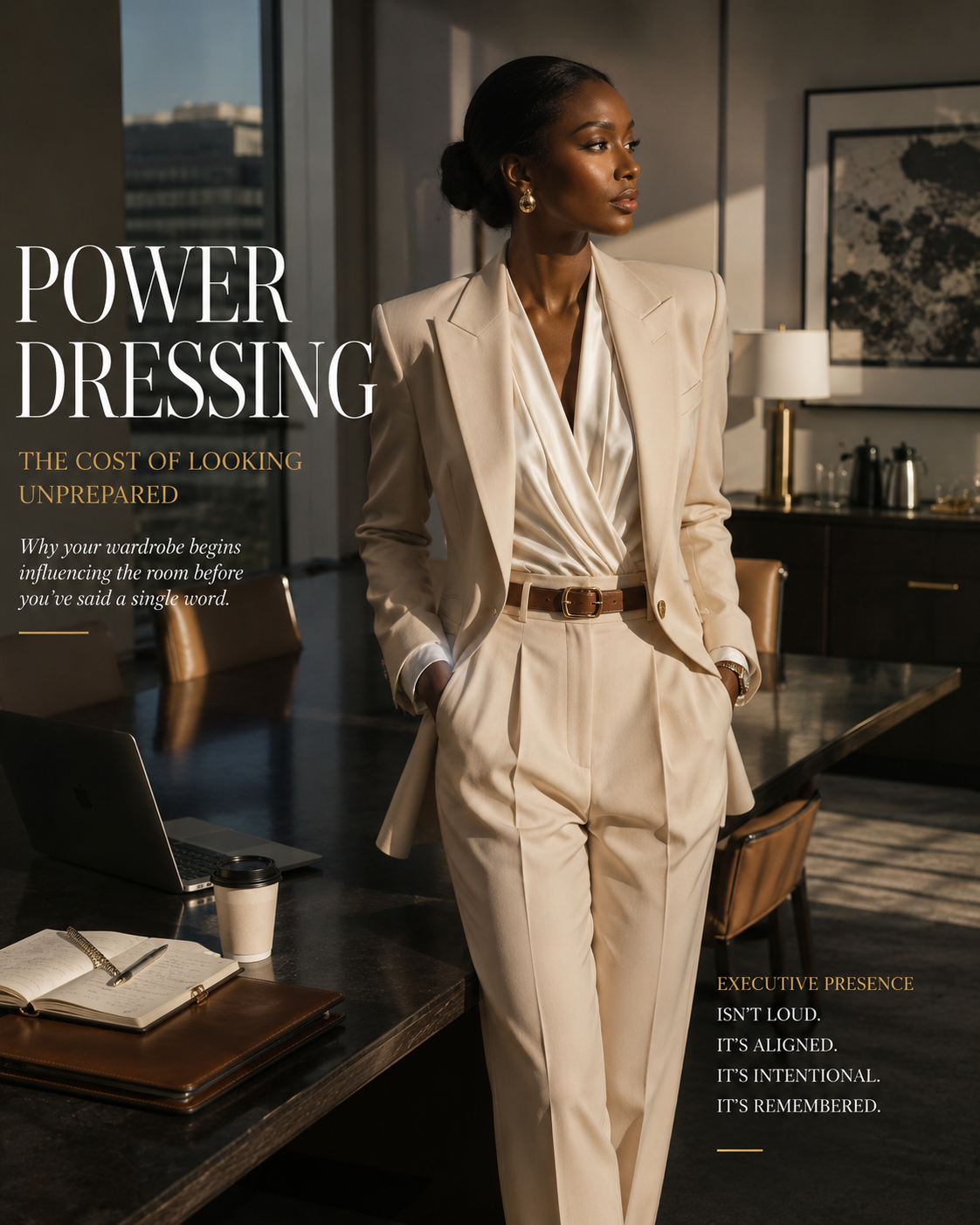
Because executive presence is not loud.
It is aligned.
It is intentional.
And long after the meeting ends, it is remembered.